


Blog
2022.04.08
Spring in Utoma, Samani
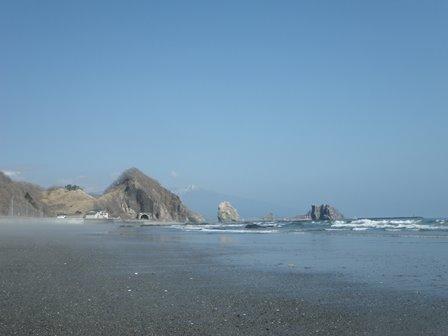
The view from Samani's Utoma district on April 5th, 2022. You can see a snow-capped Mt. Apoi in the distance, it's finally starting to look like spring.
2022.03.09
Record of Samani Disasters and Ainu Legends
The day after tomorrow is March 11th, the anniversary of the Great East Japan Earthquake. So I would like to write down what was covered during a "Hometown and Geo-study" lecture held on March 6, 2019.
Erimo Shrine "Earthquake Uminari-sora Tsunami" Stone Monument
Two monuments were erected in Erimo using donations from the 1933 Sanriku Earthquake and Tsunami. These monuments can be found in front of the Erimo Shrine and Shoya Police Station and convey the horror of the tsunami and earthquake to future generations. These two monuments are indicated by the "Natural Disaster Monument" map symbol on the when looking on the maps on the Geospatial Information Authority of Japan's website.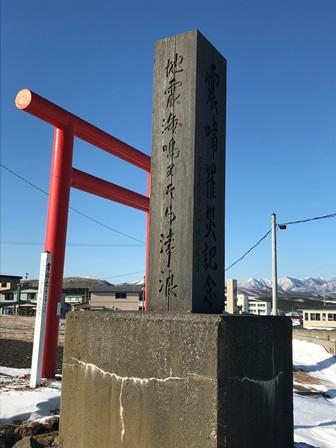
Samani Ainu Legends: Samatki Whale Bone and Tsunami
There is a series of mountain peaks that form a long line between the Shintomi district of Samani to the Kamikineusu area of neighboring Urakawa, and several of these peaks reach 600 to 700 meters in height. These mountains were called Samatki, which in Ainu means to lie down. It's said that the bones of a whale lay on the top of this mountain. There is also a story from long ago that says a whale was once washed ashore by a tsunami, and there are many people who claim to have seen the whale bones (Mt. Apoi Geopark Guidebook).
Record of Samani Disasters and Regional Tsunamis: 4 Tsunamis along the Sanriku Coast
1. August 23, 1856, Eastern Michinoku
- Magnitude 7.7 earthquake, tsunami struck Hidaka, Iburi, Oshima
- Landslides near Erimo (Usami, 2003)
- Two ships that weighed more than 500 stones were overturned near Urakawa (1 stone = 150kg, 500 stones=75 tons) (Musha, 1951)
2. June 15, 1896, Sanriku Earthquake and Tsunami
- Magnitude 8.2 earthquake occurred at 7:32 AM
- Tsunami struck the Sanriku coast 30 minutes later
- 22,000 people died from Miyagi prefecture to Hokkaido due to the earthquake and tsunami.
- No casualties in Samani from the tsunami, 6 died in Erimo due to collapsing homes (Kagami, 2006)
The tsunami in Erimo reached a height of 4 meters (Usami, 2003)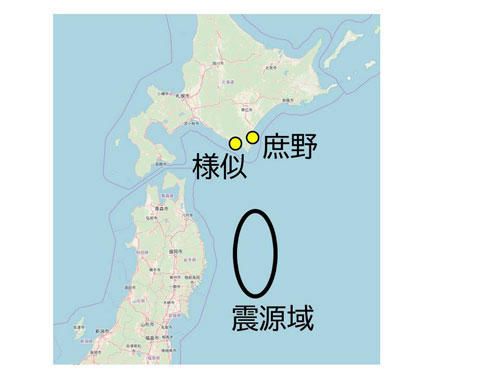
様似 = Samani, 庶野 = Shoya, 震源域 = Source of Earthquake
3. March 3, 1933 Sanriku (Showa Sanriku Earthquake)
- 37 years after the 1896 Sanriku earthquake, a magnitude 8.1 occurred at 2:30 AM.
- The tsunami struck the coast 30-60 minutes after the earthquake,
- 1 dead in Urakawa and Samani and 12 in Erimo, caused by houses and fishing boats being washed away, flooding, and debris. (Nasu/Takahashi 1933)
- 10 dead in Minomura Village and 3 in Kogoshi Village (current Erimo) (Central Meteorological Observatory, 1933)
- Three tsunami waves struck in intervals of 30 minutes after the earthquake. The third wave was 14.2 m, and left 13 dead, 56 injured, and 90 collapsed homes and buildings. The damage was estimated at 340,000 JPY (current prices around 2 trillion JPY) (Erimo Town Folk Museum)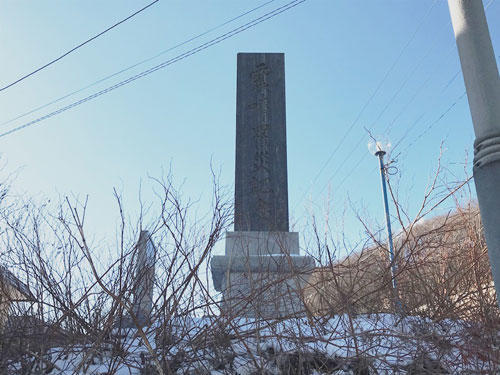
Shoya district monument in Erimo
4. Damage caused by the Great East Japan Earthquake in 2011
The Great East Japan tsunami that occurred on March 11, 2011 was also caused by an earthquake whose epicenter was near the Japan Trench off Sanriku, in the Pacific Ocean. At that time, the seismic intensity that Samani experienced was recorded as a Shindo 4 on the Shindo Scale, which was not very large. Afterward, several tsunami waves exceeding 3 meters flooded Samani. Fortunately, there was no casualties or injuries, but the damage was estimated at over 700 million yen. Damage included flooded homes, sunk fishing boats, and damage to fish processing facilities.
Follow the link for photos:
https://www.apoi-geopark.jp/other/column.html
It's important to know the historical records. I don't believe it's widely known that there were human casualties caused by past tsunamis in Samani and the surrounding towns. Also, please let us know if you have seen photographs that show old terrain (especially the coastline) and tsunami deposits of sand at the base of trees. Knowing the tsunami deposits will lead to understanding the records of past tsunamis.
2022.02.08
Samani JHS Integrated Learning Program - Part 2
Part of the junior high school curriculum focuses on the geopark and is titled, "Hometown and Apoi Studies." This year's studies have been conducted in the following steps:
Step 1. Preparational studies
Step 2. Field trip on October 20
Step 3. Group research projects, including interviews with local experts on November 5
Step 4. Poster presentations on December 8
Group research projects began on November 5th. The flora/fauna group and the geology group came by the Visitor Center. The other groups (tourism, industry, history, etc.) visited other areas around the geopark such as the Samani Industry Department, Board of Education, Tourism Information Center, the Oyaki shop, Hotel Apoi Sanso, Tojuin Temple, the Agricultural Cooperative, etc.
The flora group was shown around the Visitor Center exhibits by Mr. T, then visited Cape Enrumu to see the site of the Apoi Dream Project. The Apoi Dream Project is a nature restoration project where the students grow endemic Mt. Apoi alpine plants from seed, then transplant the seedlings back onto the mountain. 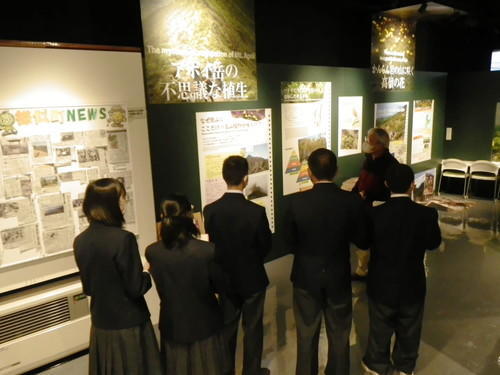
The geology group listened to a lecture at the Mt. Apoi Scientific Research and Support Center and visited the plate boundary site. They also learned about the different rocks and the National Park that includes part of Mt. Apoi Geopark. Academic advisor, Prof. N, talked about a project called "Rock Density & Mineral Hardness Experiment," and had the students conduct their own experiments to explore the diversity of the rocks for themselves. The students were surprised when they had to use arithmetic to calculate the rock density difference between peridotite and limestone, even though they were here to study geology! I was impressed when the students started connecting the dots between rocks and other things outside of earth sciences. Some of the students began to wonder out loud about how they would take the knowledge they gained from these experiments and turn it into their poster presentation.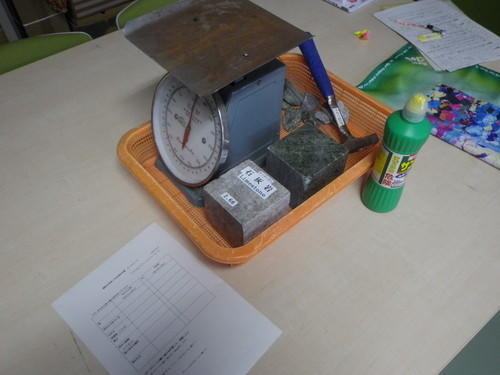
Due to the GIGA School Concept, all the students carried their own tablet and took many photos. They asked me a variety of questions while taking photos. I was rather impressed when the students began to answer each other's questions. Later they will summarize their group research project experiences to create a poster presentation. (K)
2022.02.01
Sunday, January 16 Tsunami Advisory: A Memorandum
In the early hours of Sunday, January 16th, a tsunami advisory was announced for the entire Pacific coastline of Japan from Hokkaido (including Samani) to Miyakojima. It was a cold winter night in snow-covered Samani. I talked to several people about their experience of that night and would like to record it here.
"This reminded me of when I evacuated to high ground during the 2011 Great East Japan Earthquake. It also reminded me of the 1960 Chile Earthquake and tsunami. There were around 30-40 cars that evacuated to the area around Mt. Kannon which is about 80m above sea level. I went to my closest evacuation area at Sobira-so and saw several cars doing the same. There were several trucks (not local residents) that stopped at Mt. Kannon as well. While I prepared to evacuate from my home, I turned on the news. I understood that this was a scientifically unpredictable phenomenon." 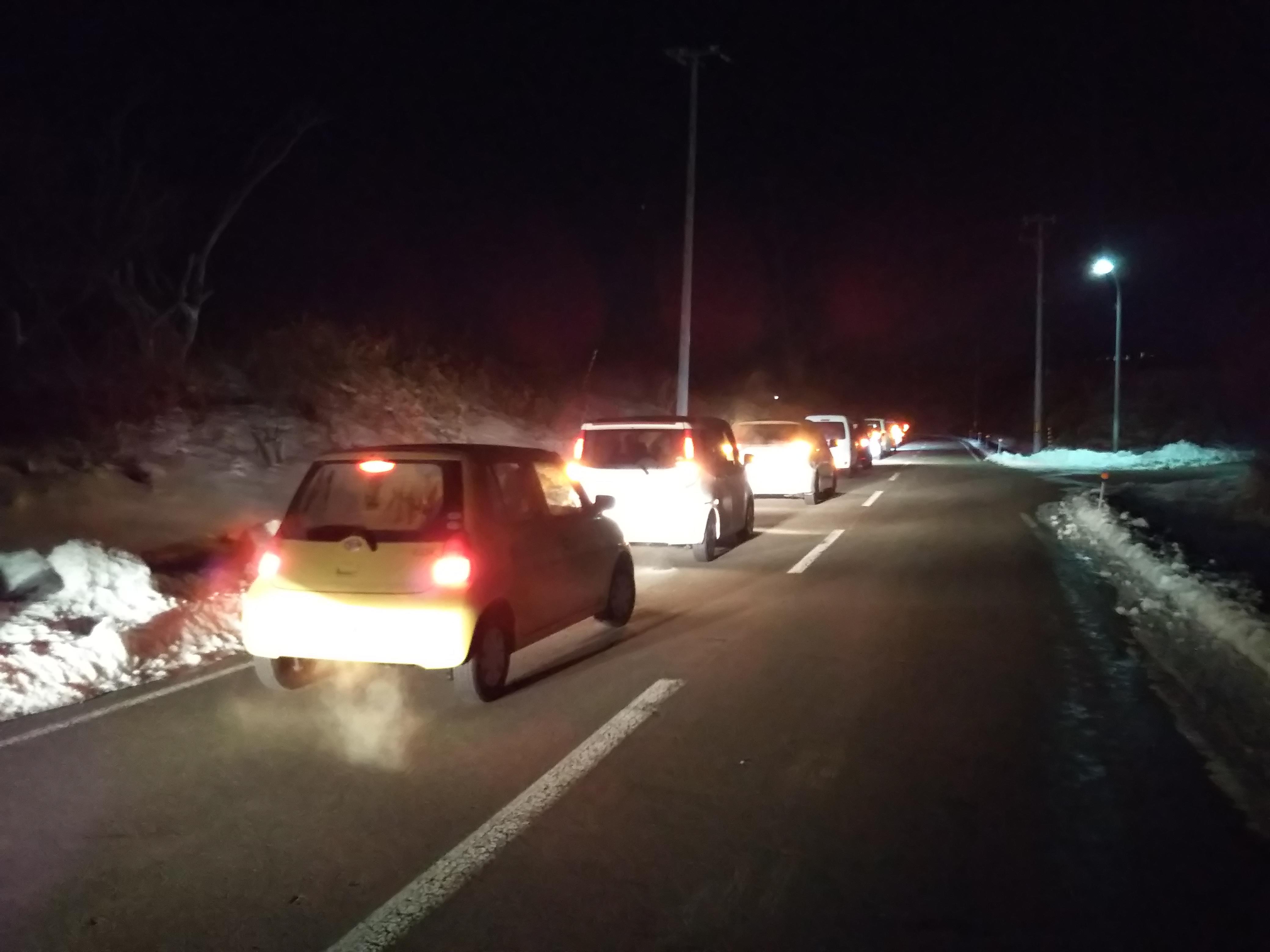
Jan 16, 12:45 AM, Cars lined up around Mt. Kannon
An employee from the Board of Education provided this photo.
Record-breaking eruption in Tonga
On Saturday, January 15th around 1:10 PM, the Hunga Tonga-Hunga Ha'apai volcano in the Tonga archipelago in the South Pacific erupted. Hunga Tonga-Hunga Ha'apai is the name of a volcanic island that was part of a sunken caldera created by previous eruptions. It is a submarine volcano located about 65km north of the capital of Nuku'alofa. The Tonga islands were covered in ash and overwhelmed by a tsunami with a height up to 15 meters. There were some islands that sustained damage to every building, 3 lives lost, and 14 injuries were confirmed. It was estimated that over 80% of the 100,000 population were affected by the tsunami and ashfall. As of January 31st, the full damage to all 170 islands was still being confirmed.
What was particular about this event is the tsunami was caused by a shockwave from the large-scale eruption. In Japan, it is thought that a large change in tide level appeared after a sudden change in the atmospheric pressure. Additionally, this tsunami made landfall faster than a typical tsunami that occurs in distant seas. It's thought that the tide level along Japan rose as waves began to overlap the farther it traveled from the eruption point. The tsunami's mechanism is historical, with no previous examples, and will continue to be difficult to predict.
While this event was very different from a tsunami caused by an earthquake, in a broad sense it is still a tsunami. This tsunami's characteristics include a relatively short-wave cycle and fast flow, with the force to move ships and rafts. For anyone who lives in an area where these high tides continue, please do not go close to the shore.
Jan 16, 2022 NHK News
Jan 31, 2022 Hokkaido Newspaper
It was determined that the change in tide level during the Krakatoa volcanic eruption in Indonesia in 1883, was not a tsunami. There is also a "seiche," where the tide level changes due to changes in atmospheric pressure, wind, and the topography of the bay, but overseas it's referred to as a "meteotsunami." The phenomenon of a seiche, or "abiki" in Japanese, where the sea level repeatedly rises and falls in a short period of time caused by resonance. A seiche was observed in Samani and all along the Hidaka region.
"Tsunami Advisory Announced in Samani"
Sunday, Jan 16 at 1:15 AM, a Tsunami Advisory was announced in Samani and neighboring Urakawa. The tide levels are as follows:
Jan 15, 8:29 PM - low tide (tide level 23)
Jan 16, 4:08 AM - high tide (tide level 125) and 1:29 PM (tide level 14
Central Hokkaido Pacific Coast Urakawa Tsunami Arrival Times
1st wave Jan 15 9:43 PM
Largest wave Jan 16 5:15 AM Height 0.7M
Looking at the actual tide level condition graph at Urakawa Port on the NOWPHAS website, the tide level continued to fluctuate during the following day.
(NOWPHAS : Nationwide Ocean Wave information network for Ports and HArbourS
The tsunami was recorded in 8 different locations around Hokkaido; no damage was reported. Around 9AM an NHK helicopter took video from the air of the estimated 70cm tsunami wave that hit Urakawa shores, but did not find any effect on the harbor or the boats lined up along the coastline. Video from Erimo that was hit by a 50cm tsunami wave confirmed that there was no damage to the fishing harbor.
NHK News "Tsunami Advisory Canceled"
Jan 16 2:00 PM - Tsunami Advisory Canceled
Some sunken or capsized boats were reported in Kochi, Tokushima, and Mie prefectures.
2021.12.28
Samani JHS Integrated Learning Program - Part 1
Part of the junior high school curriculum focuses on the geopark and is titled, "Hometown and Apoi Studies." This year's studies have been conducted in the following steps:
Step 1. Preparational studies
Step 2. Field trip on October 20
Step 3. Group research projects, including interviews with local experts on November 5
Step 4. Poster presentations on December 8
This year's theme is focusing on Samani and the Mt. Apoi Geopark as an essential part of our world. In addition to introducing aspects in town that we are internationally proud of, the students will also learn about the global geoparks and will continue their studies while appreciating Samani as an important part of the world. As part of Step 1, Mr. T gave a presentation outlining what makes our town special in comparison to the rest of the world, and Ms. D introduced a different Global Geopark, the Adamello-Brenta UNESCO Global Geopark in Italy, to the junior high school students.
Then, on October 20th we held a field trip. The students traveled around town to see different geosites like the old rock quarry behind the elementary school, Okada chise (Ainu house), Jomon period archeological site in Horoman, Toho Olivine Company, and a strawberry greenhouse. The students had the opportunity to talk to professionals in each area including local workers, Board of Education Curators, and staff from Samani's Industry Department and Commerce & Tourism Department.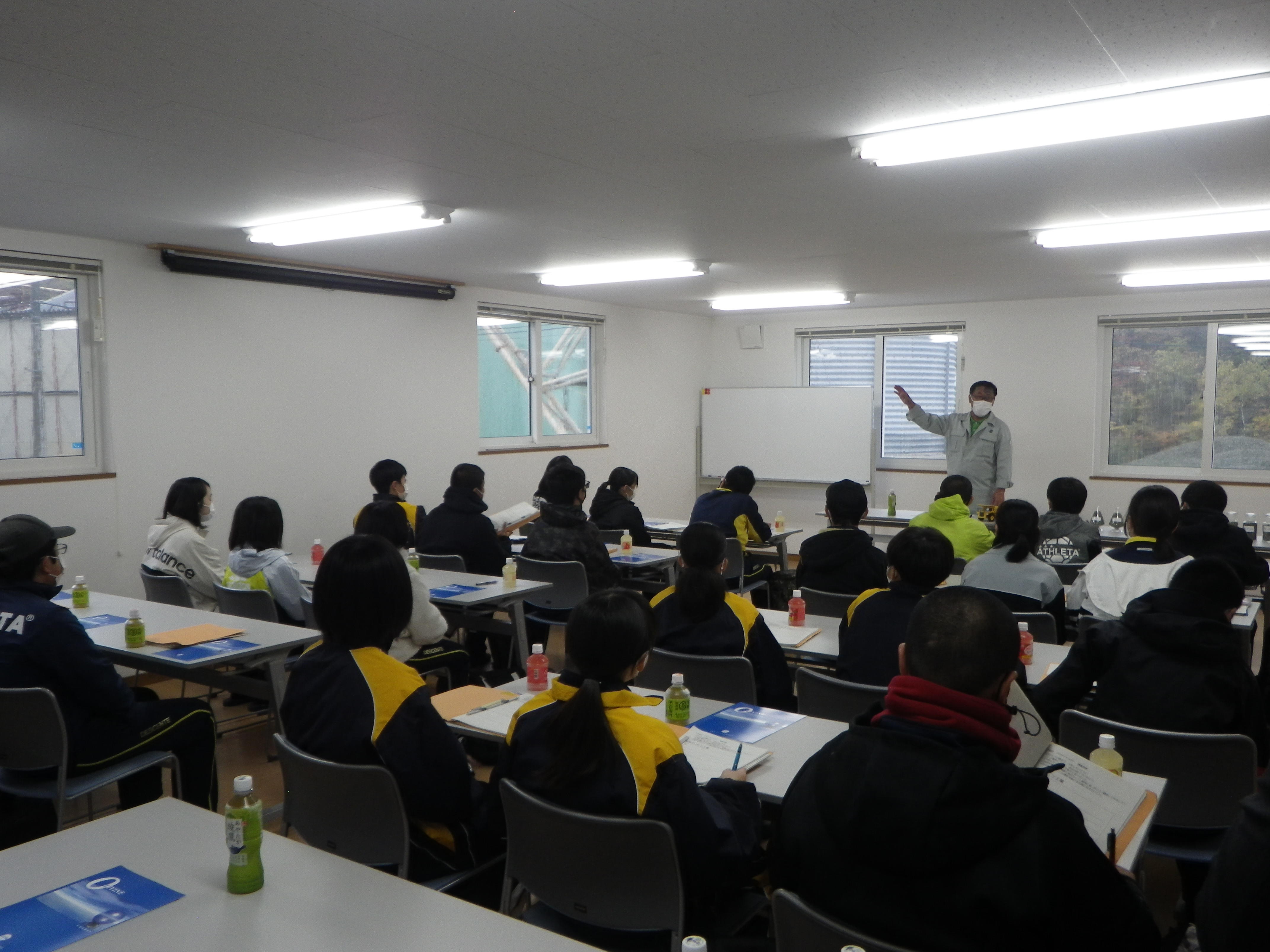
Being able to experience these locations firsthand and to hear directly from the individuals who work in the fields of nature, history, and industry is a very valuable experience. I hope that as the students will expand their horizons as they learn more about places overseas, and I also hope that they enjoy this change to learn more about their hometown as well.