


Blog
2022.02.01
Sunday, January 16 Tsunami Advisory: A Memorandum
In the early hours of Sunday, January 16th, a tsunami advisory was announced for the entire Pacific coastline of Japan from Hokkaido (including Samani) to Miyakojima. It was a cold winter night in snow-covered Samani. I talked to several people about their experience of that night and would like to record it here.
"This reminded me of when I evacuated to high ground during the 2011 Great East Japan Earthquake. It also reminded me of the 1960 Chile Earthquake and tsunami. There were around 30-40 cars that evacuated to the area around Mt. Kannon which is about 80m above sea level. I went to my closest evacuation area at Sobira-so and saw several cars doing the same. There were several trucks (not local residents) that stopped at Mt. Kannon as well. While I prepared to evacuate from my home, I turned on the news. I understood that this was a scientifically unpredictable phenomenon." 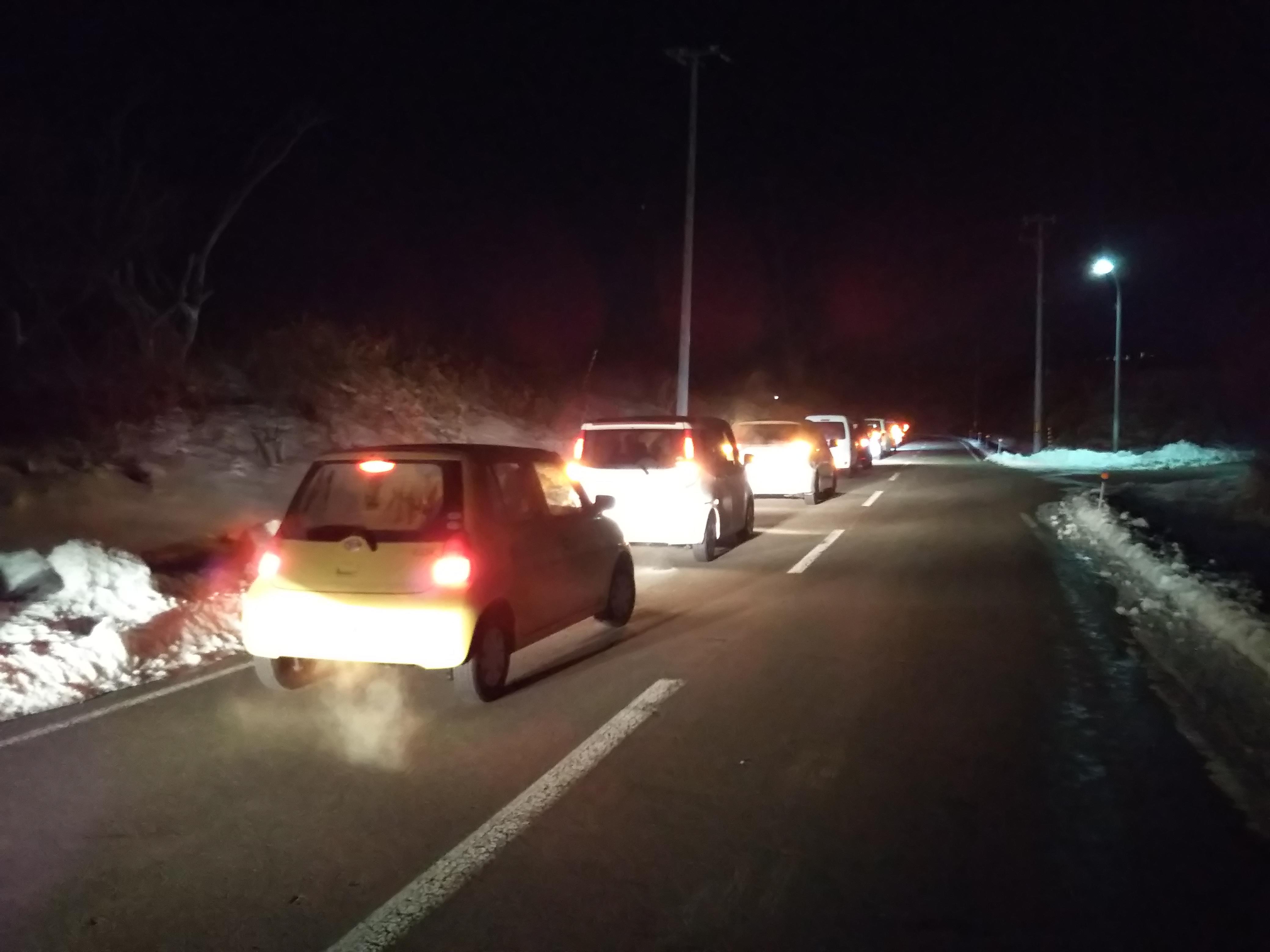
Jan 16, 12:45 AM, Cars lined up around Mt. Kannon
An employee from the Board of Education provided this photo.
Record-breaking eruption in Tonga
On Saturday, January 15th around 1:10 PM, the Hunga Tonga-Hunga Ha'apai volcano in the Tonga archipelago in the South Pacific erupted. Hunga Tonga-Hunga Ha'apai is the name of a volcanic island that was part of a sunken caldera created by previous eruptions. It is a submarine volcano located about 65km north of the capital of Nuku'alofa. The Tonga islands were covered in ash and overwhelmed by a tsunami with a height up to 15 meters. There were some islands that sustained damage to every building, 3 lives lost, and 14 injuries were confirmed. It was estimated that over 80% of the 100,000 population were affected by the tsunami and ashfall. As of January 31st, the full damage to all 170 islands was still being confirmed.
What was particular about this event is the tsunami was caused by a shockwave from the large-scale eruption. In Japan, it is thought that a large change in tide level appeared after a sudden change in the atmospheric pressure. Additionally, this tsunami made landfall faster than a typical tsunami that occurs in distant seas. It's thought that the tide level along Japan rose as waves began to overlap the farther it traveled from the eruption point. The tsunami's mechanism is historical, with no previous examples, and will continue to be difficult to predict.
While this event was very different from a tsunami caused by an earthquake, in a broad sense it is still a tsunami. This tsunami's characteristics include a relatively short-wave cycle and fast flow, with the force to move ships and rafts. For anyone who lives in an area where these high tides continue, please do not go close to the shore.
Jan 16, 2022 NHK News
Jan 31, 2022 Hokkaido Newspaper
It was determined that the change in tide level during the Krakatoa volcanic eruption in Indonesia in 1883, was not a tsunami. There is also a "seiche," where the tide level changes due to changes in atmospheric pressure, wind, and the topography of the bay, but overseas it's referred to as a "meteotsunami." The phenomenon of a seiche, or "abiki" in Japanese, where the sea level repeatedly rises and falls in a short period of time caused by resonance. A seiche was observed in Samani and all along the Hidaka region.
"Tsunami Advisory Announced in Samani"
Sunday, Jan 16 at 1:15 AM, a Tsunami Advisory was announced in Samani and neighboring Urakawa. The tide levels are as follows:
Jan 15, 8:29 PM - low tide (tide level 23)
Jan 16, 4:08 AM - high tide (tide level 125) and 1:29 PM (tide level 14
Central Hokkaido Pacific Coast Urakawa Tsunami Arrival Times
1st wave Jan 15 9:43 PM
Largest wave Jan 16 5:15 AM Height 0.7M
Looking at the actual tide level condition graph at Urakawa Port on the NOWPHAS website, the tide level continued to fluctuate during the following day.
(NOWPHAS : Nationwide Ocean Wave information network for Ports and HArbourS
The tsunami was recorded in 8 different locations around Hokkaido; no damage was reported. Around 9AM an NHK helicopter took video from the air of the estimated 70cm tsunami wave that hit Urakawa shores, but did not find any effect on the harbor or the boats lined up along the coastline. Video from Erimo that was hit by a 50cm tsunami wave confirmed that there was no damage to the fishing harbor.
NHK News "Tsunami Advisory Canceled"
Jan 16 2:00 PM - Tsunami Advisory Canceled
Some sunken or capsized boats were reported in Kochi, Tokushima, and Mie prefectures.